
Huntington County Criminal Court Records
A criminal court record is the court's case file after charges are filed. In Huntington County, that record can include the charging entry, appearances, warrants or warrant markers, bond entries, chronological case summary events, motions, pleas, dispositions, sentences, fines, fees, and final orders. The full case file is different from an arrest record. Arrest and booking details are held by law enforcement and jail systems, while the criminal court record follows the case through Circuit Court, Superior Court, and the Clerk's record process.
Local rules split criminal work between the two main Huntington County trial courts. Murder and Level 1-5 felonies generally route to Huntington Circuit Court, except Title 9 and controlled-substance cases generally go to Superior Court. Child molesting or battery-on-child allegations route to Circuit Court regardless of classification. Misdemeanors, Level 6 felonies, controlled-substance offenses, and Title 9 offenses generally route to Huntington Superior Court. Judges may transfer cases between courts by order, subject to acceptance.
For the filed charge list itself, the related Huntington County arrest records and court charges page focuses on the arrest-to-charges path. This criminal court records page stays with the full court case file and outcome.
Search Huntington County Criminal Cases
Criminal court records are searched through Indiana MyCase when they are public and available in Odyssey. Use the Case tab for a case number, citation number, or cross-reference number. Use the Name tab for a defendant name, business name, or birth date to narrow results. Use the Court dropdown for Huntington County, then apply status and filing-date filters if the search returns too many results. No MyCase search returns more than 1,000 results, so narrow searches matter. The Huntington County Clerk remains the local source for certified copies and unlinked public court documents.
- Open MyCase and select Case or Name search.
- Enter the case number, citation number, defendant name, or other known identifier.
- Limit the Court dropdown to Huntington County when possible.
- Open the case summary and review charges, bond, hearings, docket events, disposition, sentence, and financial entries.
- Contact the Huntington County Clerk when the public document is not linked or a certified copy is needed.
The Sheriff also offers a local limited criminal history check, but the official Sheriff page warns that it includes verified arrest and booking information in Huntington County only and should not be relied on to determine the actual criminal record. Criminal court records are the better source for filed charges, pleas, outcomes, and sentences.
The manifest includes the Huntington County Sheriff criminal history checks page to show that distinction.
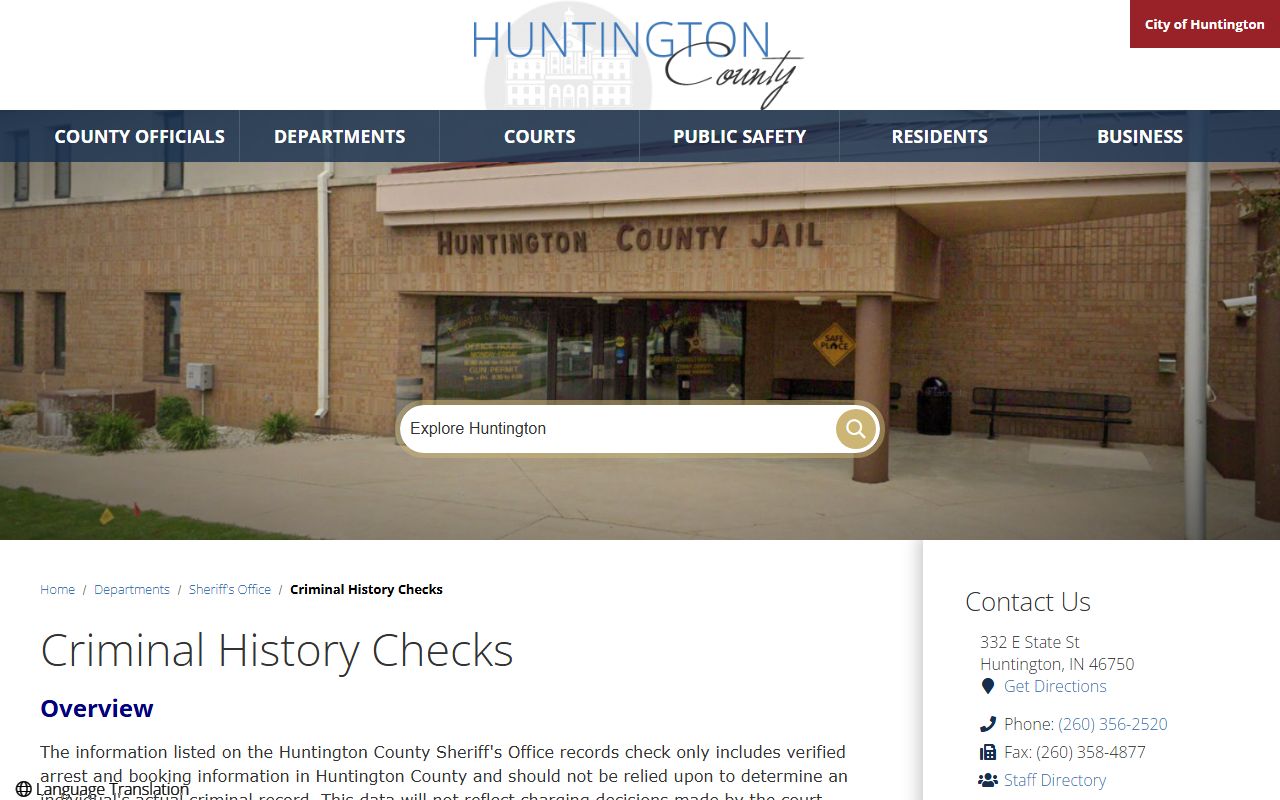
That local check can support arrest research, but court outcomes must be verified through the court case and Clerk channels.
Huntington County Criminal Case Flow
Criminal court records are easiest to read as a sequence. The arrest or investigation may occur first, but the court file becomes the main record once charges are filed. The prosecutor's office handles criminal prosecution in Huntington County, with local division assignments that include major felonies in Circuit Court and drug dealing, non-support, felonies, and misdemeanors in Superior Court. Each stage can leave a docket entry or document in the case file.
Case flow: Charges Filed › Arraignment › Pretrial / Motions › Plea or Trial › Disposition › Sentencing
| Stage | What It Adds to the Record |
|---|---|
| Charges Filed | Offense descriptions, statutes, degrees, citation numbers, and original offense levels may appear. |
| Arraignment | The court sets initial appearances, advisements, plea entries, bond, and future hearings. |
| Pretrial / Motions | Motions, continuances, discovery-related events, orders, and hearing settings can appear in the docket. |
| Plea or Trial | The record may show a plea, verdict, dismissal, acquittal, or other resolution event. |
| Disposition | The final outcome of each charge or case is recorded when public. |
| Sentencing | Sentence groups may include confinement, probation, fees, comments, conditions, and awards. |
What Huntington Criminal Records Show
MyCase case-summary fields for Huntington County criminal court records can include a case header, parties, attorneys, charges, bonds, chronological case summary events, documents, sentence groups, judgment groups, related cases, cross references, and financial information. Some fields appear only if the case type supports them and the data is public. Date of birth may help narrow a search, but DOB is excluded from public case details.
| Field | What It Shows |
|---|---|
| Case Number | The unique identifier for the criminal court record. |
| Defendant and Parties | Party names, roles, attorneys, and public party details when available. |
| Charges | Offense description, offense date, statute, degree, original degree, citation number, and modifications. |
| Bonds | Bond number, amount, status date, and status. |
| Docket Events | Hearings, motions, orders, dispositions, sentence events, violations, and appellate entries. |
| Documents | Linked public filings or orders when MyCase makes them available. |
| Disposition | The result of a charge or case, such as dismissed, guilty, or another court outcome. |
| Sentence | Confinement, probation, fees, comments, conditions, and related sentence data when entered. |
| Financial | Fee summaries, transactions, balances, credits, and payments, with official balances from the Clerk. |
Charges vs Convictions
A Huntington County criminal court record can show charges that never became convictions. A charge is an allegation filed in court. A conviction is a guilty plea, guilty verdict, or other finding of guilt. The difference matters because a case can include dismissed charges, reduced charges, amended charges, or charges that end in acquittal. The court record should be read charge by charge, not just by case caption.
| Topic | Charge | Conviction |
|---|---|---|
| Meaning | A formal accusation that a statute or ordinance was violated. | A finding or plea of guilt on a criminal offense. |
| Where It Appears | Charge section, docket entries, complaint, information, or related filing. | Disposition and sentence sections when entered. |
| Can Change? | Yes, charges may be amended, reduced, added, or dismissed. | The final record changes only through later court action, appeal, or expungement process. |
| Search Caution | Do not treat a filed charge as proof of guilt. | Confirm the disposition and sentence for the exact charge. |
Dispositions and Sentences
The disposition tells how a charge or case resolved. In Huntington County criminal court records, disposition entries may appear with the charge record, chronological case summary, sentence events, or judgment events. A dismissal is not the same as a conviction. A guilty plea is not the same as a pending charge. A sentence is the punishment or conditions ordered after conviction and may include confinement, probation, fines, fees, or other court-ordered terms.
Bond and financial entries require separate care. Huntington County jail bond types include cash, 10 percent cash, surety, split, and own recognizance, but those bond records are not the final criminal case outcome. MyCase warns that online financial balances may not reflect recent payments, new charges, or interest. The official balance comes from the Clerk.
Sealed vs Expunged Records
Indiana expungement and sealing are governed by IC 35-38-9. The research notes that arrest-only or charge-only records that did not result in conviction, or that were vacated, can be treated differently from conviction records. Conviction expungement categories depend on offense level and waiting period. Serious felony categories can involve longer waiting periods and prosecutor-consent issues. Huntington County filers use state self-service forms as a starting point but must follow local procedures.
| Topic | Sealed | Expunged |
|---|---|---|
| Public Visibility | Closed from ordinary public view by law or court order. | Removed or restricted from public access depending on the granted expungement type. |
| MyCase Effect | May not display publicly if sealed. | Pending or denied cases may appear; granted expungements may be removed. |
| Process | Requires legal basis or court order. | Requires a petition process under Indiana law. |
| Caution | The order controls access. | Do not promise complete erasure across all agencies. |
Public Access to Criminal Court Records
Public access to Huntington County criminal court records is shaped by Indiana's Access to Public Records Act, Indiana Rules on Access to Court Records, and Indiana court public-access guidance. Adult criminal case summaries are often public in MyCase, but confidential documents, sealed cases, expunged records, juvenile matters, mental health matters, and protected identifiers can be withheld or redacted.
Public access also depends on where the case was filed. State criminal cases from Huntington County use the local courts and MyCase. Federal criminal cases tied to Huntington County do not appear in MyCase. Huntington County belongs to the Northern District of Indiana, Fort Wayne Division for federal district court purposes, so federal case records use PACER or the specific federal court's CM/ECF system.
The manifest includes PACER's Find a Case page for federal criminal case searches that are separate from Huntington County criminal court records.
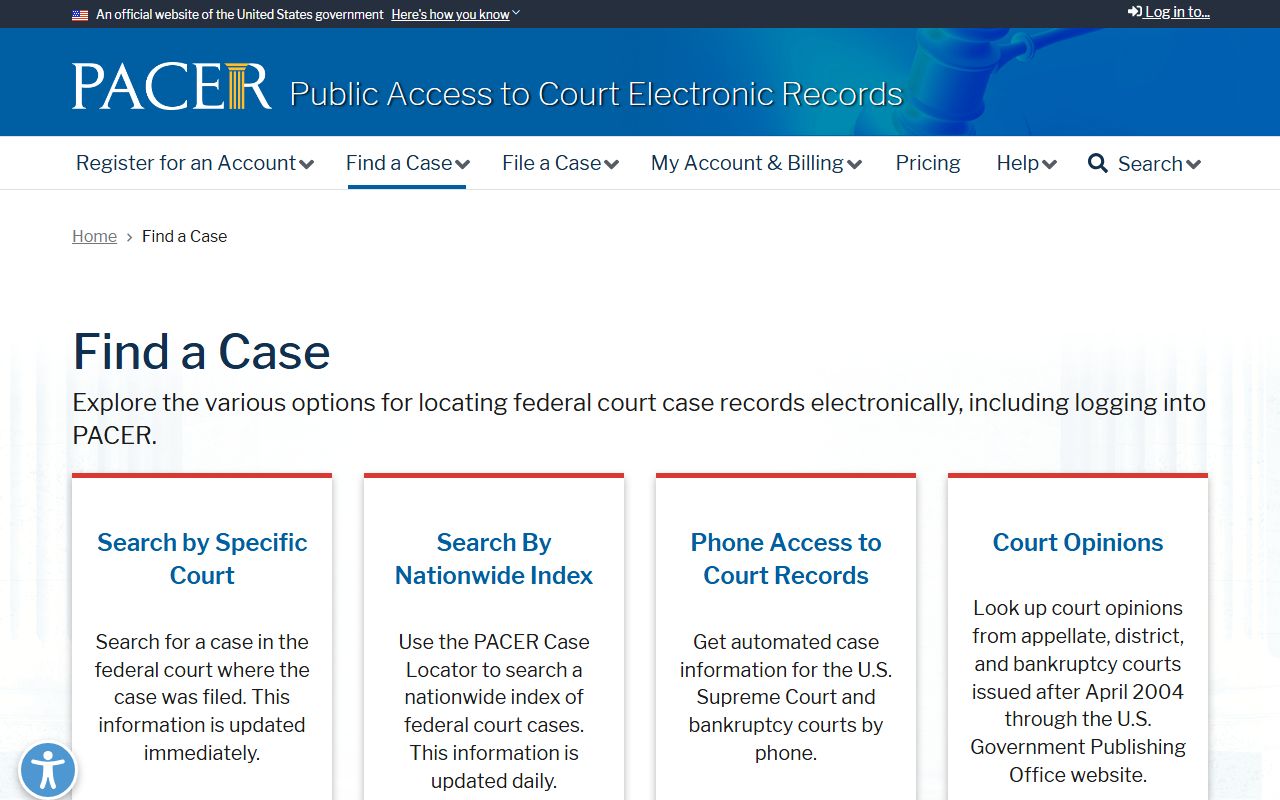
That federal search path matters only when the case is in federal court, not when the case is a Huntington Circuit Court or Superior Court prosecution.
Restricted Huntington Criminal Records
Juvenile cases are assigned to Huntington Circuit Court and have special access limits under Indiana law. Sealed and expunged criminal records may be removed from ordinary public access. Protection order cases are not found through regular MyCase name search because protected-person identifying information is excluded from online access. Personal identifiers, including date of birth in case details, Social Security numbers, account numbers, minor information, and other confidential data, are excluded or redacted under access rules.
Note: The court case and Clerk record should control outcome questions; local arrest checks are limited and do not prove final criminal history.